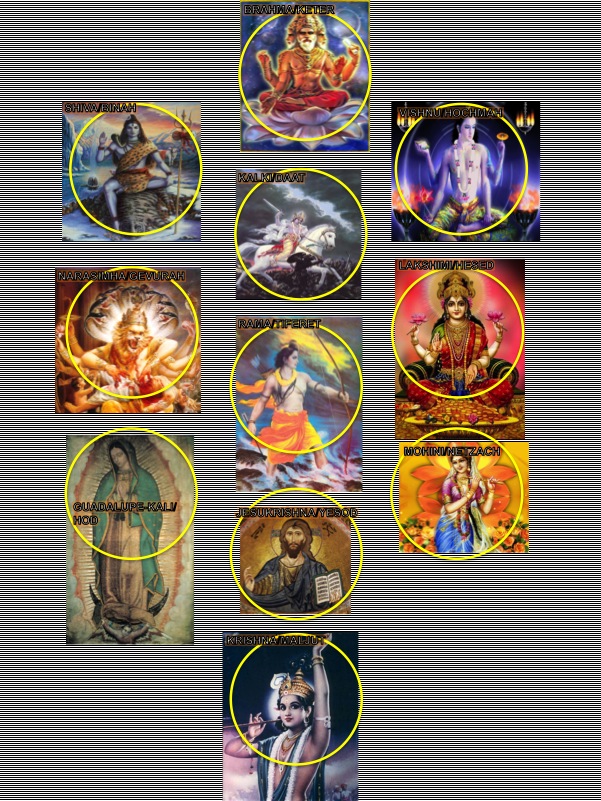
El Árbol de la Vida de Narayana
Este estudio pretende utilizar la teología comparativa para dar a conocer un aspecto que conjuga varios estudios y mitologías que nos hacen reflexionar en lo divino.
✨ Kéter – La Corona
En la cima del Árbol de la Vida se encuentra Kéter, la Corona, el punto de origen absoluto. Es el misterio más profundo, la realidad incognoscible que precede a toda forma. En la tradición cabalística, Kéter es la fuente de todas las emanaciones, pero permanece velada, inaccesible para el entendimiento humano. En este ensayo, propongo una correspondencia entre Kéter y Brahma, el principio creador del hinduismo, pero también con esa dimensión de Alá que permanece fuera de todo nombre y forma, como lo insinúa el Alef silencioso que antecede la primera letra de la Torá.
La Torá comienza con la letra Bet, no con Alef, quizá como señal de que el verdadero origen es incomprensible para la mente humana. Alef representa lo no dicho, lo que está más allá del lenguaje. De manera análoga, Brahma, en su forma más elevada, es pura potencialidad, no aún creación. Así, Kéter es la idea divina antes de manifestarse, la chispa del Ser antes del ser. No es Dios como lo imaginamos, sino como lo intuye el alma: un abismo de luz.
✨ Jojmá – Sabiduría
De Kéter emana Jojmá, la Sabiduría primordial, la semilla de toda creación. Es un punto masculino, activo, fecundador. Aquí identificamos al Señor Vishnú, la segunda persona de la Trimurti hindú, como principio organizador del universo. Vishnú no es solo el preservador del cosmos, sino también el arquetipo del Hijo amado, bello, sabio y lleno de compasión. Su esencia armonizadora y su dominio sobre el orden cósmico reflejan las cualidades de Jojmá: sabiduría dinámica, visión, irradiación creativa.
En la tradición cristiana, este papel ha sido atribuido al Logos, al Cristo como principio de sabiduría encarnada. Sin embargo, aquí lo identificamos con Vishnú, que contiene en sí mismo la gracia, la majestad y la capacidad de equilibrar todas las fuerzas del universo con diplomacia divina. Jojmá no es conocimiento intelectual, sino sabiduría viva: una sabiduría que canta y danza a través de las formas.
✨ Biná – Entendimiento
Como respuesta a Jojmá, surge Biná, el Entendimiento, principio femenino, receptivo, que da forma a la semilla sembrada por la Sabiduría. Si Jojmá es la chispa, Biná es el útero que la acoge y la desarrolla. Aquí propongo a Shiva como símbolo de esta conciencia profunda que contempla y comprende la totalidad de la creación. No el Shiva destructor, sino el Shiva meditativo, el que en su silencio eterno contempla el ciclo de la existencia.
En su aspecto más elevado, Shiva alcanza el estado de Shambho, la conciencia pura y eterna. Esta conciencia se asemeja al Shabat, el descanso sagrado, la detención del tiempo que permite ver las cosas tal como son. Shiva, en esta lectura, es el Saturno místico, señor del tiempo y del entendimiento. En Biná, la creación adquiere estructura, sentido, profundidad. Es el templo interior donde el espíritu toma forma.
✨ Daat – Conocimiento Oculto
Daat no es una sefirá fija en todos los esquemas cabalísticos; más bien, es un punto oculto, una intersección entre el intelecto superior y el corazón. Representa el conocimiento espiritual profundo, no como información, sino como experiencia directa de la verdad. En este punto ubico al Avatar Kalki, aún por manifestarse según la tradición hindú. Kalki, el décimo y último avatar de Vishnú, cabalga hacia el fin del ciclo para restaurar el dharma y revelar la verdad olvidada.
Kalki encarna el conocimiento que irrumpe cuando todo ha sido corrompido. Por eso, puede ser incomprendido, rechazado o temido. Como Daat, se encuentra en el umbral entre la iluminación y la confusión. Su aparición desafía las estructuras establecidas. Algunos podrán llamarlo “anticristo”, pero no por maldad, sino por el choque que produce toda verdad que desenmascara la ilusión.
✨ Jésed – Misericordia
Jésed es la expansión amorosa de la divinidad. Aquí todo se entrega sin medida: gracia, compasión, belleza. Es el flujo generoso del amor divino. En este espacio ubicamos a Lakshmi, consorte de Vishnú y diosa de la fortuna, la devoción y la armonía. Lakshmi no solo representa la abundancia material, sino la ternura que sostiene al mundo. Es el aspecto femenino de Narayana, su complemento inseparable.
En la mitología griega, podríamos compararla con Atenea, diosa de la sabiduría y la protección estratégica, que también actúa en favor del equilibrio. Jésed es la energía que da sin exigir, la apertura incondicional del corazón.
✨ Gevurá – Severidad, Justicia
Frente a Jésed se encuentra Gevurá, la fuerza restrictiva, la ley, el límite necesario. No como castigo, sino como estructura que permite la existencia. Aquí se manifiesta Narasimha, el Avatar leonino de Vishnú que destruye al demonio Hiranyakashipu. Narasimha representa la justicia inquebrantable, el poder que aparece cuando todo lo demás falla, el rugido de lo divino ante la injusticia.
La frase que sintetiza esta sefirá podría ser: “Mientras no dañes a otro, haz como quieras.” Pero si cruzas el límite del daño, la ley se activa con precisión implacable. Gevurá enseña que el amor sin límites puede destruir, y que la justicia sin amor es estéril. Solo juntas dan forma al equilibrio.
✨ Tiféret – Belleza, Verdad Central
En el centro del Árbol está Tiféret, la belleza que nace del equilibrio entre misericordia y justicia. Es el corazón del Árbol, el alma radiante del cosmos. Aquí encontramos a Lord Rama, el príncipe perfecto, encarnación de la virtud, la fidelidad, el honor. Su historia en el Ramayana es la del héroe divino que lucha no por sí mismo, sino por el amor, la verdad y la restauración del orden.
Tiféret es el sol interior, el eje dorado que irradia armonía y poder. En la tradición cristiana, se asocia con la figura de Cristo glorificado o el “Santísimo Sacramento”, centro de devoción luminosa. En Rama vemos la majestad serena del verdadero Rey, que gobierna con sabiduría y entrega.
✨ Netzaj – Victoria, Energía Creativa
Netzaj representa la fuerza del deseo, la persistencia, la belleza irresistible que impulsa a la acción. Aquí colocamos a Mohini, la única encarnación femenina de Vishnú, cuya seducción y encanto son tan poderosos que incluso el ascético Shiva fue cautivado. De esa unión nace el dios Ayappa, símbolo de síntesis y superación espiritual.
Mohini no es solo belleza externa: es la victoria de la vida sobre la inercia, el magnetismo que lleva al alma hacia lo divino. Netzaj es danza, arte, conquista, gozo. En ella vive el misterio de la forma y la atracción, el esplendor que mueve los corazones.
✨ Hod – Esplendor, Verdad Oculta
Si Netzaj es la victoria por el deseo, Hod es la humildad de la estructura, la verdad velada en símbolos, el esplendor contenido. Aquí se encuentran dos imágenes poderosas: la Virgen de Guadalupe y la diosa Kali.
La Virgen de Guadalupe, en su iconografía, aparece como la Señora de las Estrellas, coronada y firme, con un niño a sus pies que porta la luna en la frente. Ese niño no es otro que Shiva, en su forma más pura e inocente ante lo sublime de la Madre. Guadalupe es aquí el rostro severo de la compasión, el principio femenino que equilibra la destrucción de Kali con la ternura del refugio. Hod es el templo, el lenguaje, el misterio revelado a quien sabe ver.
✨ Yesod – Fundamento, Unión
Yesod es la unión de todas las energías anteriores, el puente entre lo invisible y lo visible. Es el fundamento espiritual sobre el que se construye el mundo. Aquí encontramos a Jesús, el Cristo, como una encarnación no solo del Logos, sino de la danza cósmica de Shiva y Vishnú: el Hari Hara.
Jesús entrega su vida como acto de amor supremo y de transformación universal. Su crucifixión es una danza de destrucción de la vieja conciencia, y su resurrección, la apertura a un nuevo mundo. Yesod es el lugar del sacrificio sagrado, del amor que une lo divino y lo humano, del cuerpo como templo del alma.
✨ Maljut – Reino
En el nivel más bajo, pero no menos sagrado, se encuentra Maljut, el Reino. Aquí la divinidad se manifiesta plenamente en la materia, en la historia, en la vida cotidiana. El trono está vacío para ser habitado por el alma despierta. Pero en esta visión espiritual, propongo que Krishna es el Reino dorado anhelado, el amor absoluto hecho forma.
Krishna es el pastor divino, el amante cósmico, el rey que toca la flauta en el corazón del universo. En él confluyen todas las sefirot, como colores en una luz blanca. Su presencia en Maljut es el recordatorio de que el Reino de Dios no está lejos, sino danzando aquí, en cada instante.
✨ Conclusión – El Árbol que Une Cielo y Tierra
El Árbol de la Vida no es propiedad de una tradición ni de un pueblo. Es un arquetipo universal, un reflejo del alma humana en su anhelo eterno por el Origen. En este Árbol hemos visto cómo se entrelazan nombres distintos, formas distintas, pero una sola energía divina. Kéter y Brahma, Vishnú y Jojmá, Shiva y Biná, Jesús y Yesod, Krishna y el Reino. No se contradicen; se contemplan.
La mística no busca confundir, sino unir. No borra las diferencias, sino que las honra como manifestaciones del Uno. Cada religión es una rama del Árbol, y cada rama tiene su flor, su fruto, su sombra sagrada. En la danza entre lo masculino y lo femenino, entre la expansión y la restricción, entre la sabiduría y el misterio, encontramos no solo a Dios, sino a nosotros mismos reflejados en Él.
Narayana, Vishnú, Krishna, el Santo Nombre que vibra en todas las lenguas, desciende a cada sefirá para recordarnos que todo lo creado está sostenido por lo inefable. Y que el propósito último del Árbol no es el conocimiento por sí mismo, sino el Amor. Amor que juzga con compasión, que da sin exigir, que destruye lo falso y sostiene lo verdadero.
Quiera el lector ver en este Árbol no una doctrina nueva, sino una invitación a mirar más allá de los nombres. Que cada uno, desde su camino, descubra que la raíz es una y la savia es la misma. Y que al final del viaje espiritual, todos los nombres caen, y solo queda el Silencio que canta el Nombre eterno: Narayana.
The Tree of Life of Narayana
This study seeks to use comparative theology to reveal an aspect that brings together several traditions and mythologies that invite us to reflect on the divine.
✨ Keter – The Crown
At the summit of the Tree of Life stands Keter, the Crown, the point of absolute origin. It is the deepest mystery, the unknowable reality that precedes all form. In the Kabbalistic tradition, Keter is the source of all emanations, yet it remains veiled, inaccessible to human understanding. In this essay, I propose a correspondence between Keter and Brahma, the creative principle of Hinduism, but also with that dimension of Allah which remains beyond all name and form, as suggested by the silent Alef that precedes the first letter of the Torah.
The Torah begins with the letter Bet, not Alef, perhaps as a sign that the true origin is incomprehensible to the human mind. Alef represents what is unsaid, what lies beyond language. Similarly, Brahma in his highest form is pure potentiality, not yet creation. Thus, Keter is the divine idea before it manifests, the spark of Being before being. It is not God as we imagine Him, but as the soul intuits Him: an abyss of light.
✨ Chokhmah – Wisdom
From Keter emanates Chokhmah, primordial Wisdom, the seed of all creation. It is a masculine, active, fecundating point. Here we identify Lord Vishnu, the second person of the Hindu Trimurti, as the organizing principle of the universe. Vishnu is not only the preserver of the cosmos, but also the archetype of the beloved Son, beautiful, wise and full of compassion. His harmonizing essence and his sovereignty over the cosmic order reflect the qualities of Chokhmah: dynamic wisdom, vision, creative radiance.
In the Christian tradition, this role has been attributed to the Logos, to Christ as the principle of incarnate wisdom. Here, however, we identify it with Vishnu, who contains within himself grace, majesty and the capacity to balance all the forces of the universe with divine diplomacy. Chokhmah is not intellectual knowledge but living wisdom: a wisdom that sings and dances through forms.
✨ Binah – Understanding
As a response to Chokhmah arises Binah, Understanding, a feminine, receptive principle that gives shape to the seed sown by Wisdom. If Chokhmah is the spark, Binah is the womb that receives it and develops it. Here I propose Shiva as a symbol of this deep consciousness that contemplates and understands the totality of creation. Not Shiva the destroyer, but the meditative Shiva, who in his eternal silence contemplates the cycle of existence.
In his highest aspect, Shiva attains the state of Shambho, pure and eternal consciousness. This consciousness resembles the Shabbat, the sacred rest, the stopping of time that allows things to be seen as they are. Shiva, in this reading, is the mystical Saturn, lord of time and understanding. In Binah, creation acquires structure, meaning, depth. It is the inner temple where the spirit takes form.
✨ Da‘at – Hidden Knowledge
Da‘at is not a fixed sefirah in all Kabbalistic diagrams; rather, it is a hidden point, an intersection between the higher intellect and the heart. It represents deep spiritual knowledge, not as information, but as an immediate experience of truth. At this point I place the Avatar Kalki, yet to be manifested according to the Hindu tradition. Kalki, the tenth and final avatar of Vishnu, rides forth at the end of the cycle to restore dharma and reveal forgotten truth.
Kalki embodies the knowledge that breaks in when everything has been corrupted. For that reason he can be misunderstood, rejected or feared. Like Da‘at, he stands at the threshold between illumination and confusion. His appearance challenges established structures. Some may call him an “antichrist,” not because of evil, but because of the shock produced by any truth that unmasks illusion.
✨ Chesed – Mercy
Chesed is the loving expansion of the divinity. Here everything is given without measure: grace, compassion, beauty. It is the generous flow of divine love. In this sphere we place Lakshmi, consort of Vishnu and goddess of fortune, devotion and harmony. Lakshmi does not only represent material abundance, but the tenderness that sustains the world. She is the feminine aspect of Narayana, his inseparable complement.
In Greek mythology we might compare her with Athena, goddess of wisdom and strategic protection, who also acts in favor of balance. Chesed is the energy that gives without demanding, the unconditional openness of the heart.
✨ Gevurah – Severity, Justice
Opposite Chesed we find Gevurah, the restrictive force, the law, the necessary limit. Not as punishment, but as the structure that makes existence possible. Here Narasimha appears, the leonine Avatar of Vishnu who destroys the demon Hiranyakashipu. Narasimha represents unbreakable justice, the power that arises when everything else has failed, the roar of the divine in the face of injustice.
The phrase that sums up this sefirah could be: “As long as you harm no other, do what you will.” But if you cross the boundary of harm, the law is activated with relentless precision. Gevurah teaches that love without limits can destroy, and that justice without love is sterile. Only together do they shape true balance.
✨ Tiferet – Beauty, Central Truth
At the center of the Tree stands Tiferet, the beauty born from the balance between mercy and justice. It is the heart of the Tree, the radiant soul of the cosmos. Here we find Lord Rama, the perfect prince, embodiment of virtue, fidelity and honor. His story in the Ramayana is that of the divine hero who fights not for himself, but for love, truth and the restoration of order.
Tiferet is the inner sun, the golden axis that radiates harmony and power. In the Christian tradition it is associated with the figure of the glorified Christ or the “Blessed Sacrament,” center of luminous devotion. In Rama we see the serene majesty of the true King, who rules with wisdom and self-offering.
✨ Netzach – Victory, Creative Energy
Netzach represents the strength of desire, persistence, the irresistible beauty that impels to action. Here we place Mohini, the only feminine incarnation of Vishnu, whose seduction and charm are so powerful that even the ascetic Shiva was captivated. From that union is born the god Ayappa, a symbol of synthesis and spiritual transcendence.
Mohini is not only outward beauty; she is the victory of life over inertia, the magnetism that draws the soul toward the divine. Netzach is dance, art, conquest, joy. In her lives the mystery of form and attraction, the splendor that moves hearts.
✨ Hod – Splendor, Hidden Truth
If Netzach is victory through desire, Hod is the humility of structure, the truth veiled in symbols, contained splendor. Here two powerful images meet: Our Lady of Guadalupe and the goddess Kali.
In her iconography, Our Lady of Guadalupe appears as the Lady of the Stars, crowned and firm, with a child at her feet who bears the moon on his forehead. That child is none other than Shiva, in his purest and most innocent form before the sublimity of the Mother. Guadalupe is here the severe face of compassion, the feminine principle that balances the destruction of Kali with the tenderness of refuge. Hod is the temple, the language, the mystery revealed to those who know how to see.
✨ Yesod – Foundation, Union
Yesod is the union of all the previous energies, the bridge between the invisible and the visible. It is the spiritual foundation upon which the world is built. Here we find Jesus, the Christ, as an incarnation not only of the Logos, but of the cosmic dance of Shiva and Vishnu: Hari Hara.
Jesus gives his life as an act of supreme love and universal transformation. His crucifixion is a dance of destruction of the old consciousness, and his resurrection the opening to a new world. Yesod is the place of sacred sacrifice, of the love that unites the divine and the human, of the body as temple of the soul.
✨ Malkhut – Kingdom
On the lowest level, though no less holy, we find Malkhut, the Kingdom. Here divinity is fully manifested in matter, in history, in everyday life. The throne is empty, ready to be inhabited by the awakened soul. Yet in this spiritual vision I propose that Krishna is the longed-for golden Kingdom, absolute love made form.
Krishna is the divine shepherd, the cosmic lover, the king who plays the flute in the heart of the universe. In him all the sefirot converge like colors in white light. His presence in Malkhut is the reminder that the Kingdom of God is not far away, but dancing here in every instant.
✨ Conclusion – The Tree that Unites Heaven and Earth
The Tree of Life does not belong to any one tradition or people. It is a universal archetype, a reflection of the human soul in its eternal longing for the Origin. In this Tree we have seen how different names and forms interweave, yet only one divine energy moves through them. Keter and Brahma, Vishnu and Chokhmah, Shiva and Binah, Jesus and Yesod, Krishna and the Kingdom. They do not contradict one another; they contemplate one another.
Mysticism does not seek to confuse, but to unite. It does not erase differences, but honors them as manifestations of the One. Each religion is a branch of the Tree, and each branch has its flower, its fruit, its sacred shade. In the dance between masculine and feminine, between expansion and restriction, between wisdom and mystery, we find not only God, but ourselves reflected in Him.
Narayana, Vishnu, Krishna, the Holy Name that vibrates in all tongues, descends into each sefirah to remind us that all creation is sustained by the Ineffable. And that the ultimate purpose of the Tree is not knowledge for its own sake, but Love. Love that judges with compassion, that gives without demanding, that destroys what is false and upholds what is true.
May the reader see in this Tree not a new doctrine, but an invitation to look beyond names. May each one, from his or her own path, discover that the root is one and the sap is the same. And that at the end of the spiritual journey, all names fall away, and only the Silence remains, singing the eternal Name: Narayana.
Der Lebensbaum Narayanas
Diese Studie möchte die vergleichende Theologie nutzen, um einen Aspekt sichtbar zu machen, der verschiedene Studien und Mythologien verbindet und uns zum Nachdenken über das Göttliche anregt.
✨ Keter – Die Krone
An der Spitze des Lebensbaums steht Keter, die Krone, der Punkt des absoluten Ursprungs. Es ist das tiefste Geheimnis, die unerkennbare Wirklichkeit, die jeder Form vorausgeht. In der kabbalistischen Tradition ist Keter die Quelle aller Emanationen, bleibt aber verhüllt, dem menschlichen Verstand unzugänglich. In diesem Essay schlage ich eine Entsprechung zwischen Keter und Brahma vor, dem schöpferischen Prinzip des Hinduismus, aber auch mit jener Dimension von Allah, die jenseits aller Namen und Formen bleibt, wie es das schweigende Alef andeutet, das dem ersten Buchstaben der Tora vorausgeht.
Die Tora beginnt mit dem Buchstaben Bet, nicht mit Alef – vielleicht als Zeichen dafür, dass der wahre Ursprung für den menschlichen Geist unbegreiflich ist. Alef steht für das Ungesagte, das, was jenseits der Sprache liegt. Ebenso ist Brahma in seiner höchsten Gestalt reine Potentialität, noch nicht Schöpfung. So ist Keter der göttliche Gedanke vor seiner Manifestation, der Funke des Seins vor dem Sein. Es ist nicht Gott, wie wir ihn uns vorstellen, sondern wie ihn die Seele ahnt: ein Abgrund aus Licht.
✨ Chokhmah – Weisheit
Aus Keter geht Chokhmah hervor, die ursprüngliche Weisheit, der Same aller Schöpfung. Sie ist ein männliches, aktives, zeugendes Prinzip. Hier erkennen wir Herrn Vishnu, die zweite Person der hinduistischen Trimurti, als ordnendes Prinzip des Universums. Vishnu ist nicht nur der Erhalter des Kosmos, sondern auch das Urbild des geliebten Sohnes, schön, weise und voller Mitgefühl. Sein harmonisierendes Wesen und seine Herrschaft über die kosmische Ordnung spiegeln die Eigenschaften von Chokhmah wider: dynamische Weisheit, Schau, schöpferische Ausstrahlung.
In der christlichen Tradition wurde diese Rolle dem Logos zugeschrieben, Christus als Prinzip der verkörperten Weisheit. Hier jedoch identifizieren wir sie mit Vishnu, der in sich selbst Gnade, Majestät und die Fähigkeit trägt, alle Kräfte des Universums mit göttlicher Diplomatie auszubalancieren. Chokhmah ist kein intellektuelles Wissen, sondern lebendige Weisheit – eine Weisheit, die durch die Formen hindurch singt und tanzt.
✨ Binah – Verstehen
Als Antwort auf Chokhmah entsteht Binah, das Verstehen – ein weibliches, empfangendes Prinzip, das dem von der Weisheit gesäten Samen Gestalt verleiht. Wenn Chokhmah der Funke ist, dann ist Binah der Schoß, der ihn aufnimmt und entfaltet. Hier schlage ich Shiva als Symbol für dieses tiefe Bewusstsein vor, das die Gesamtheit der Schöpfung betrachtet und begreift. Nicht den zerstörerischen Shiva, sondern den meditativen Shiva, der in seinem ewigen Schweigen den Zyklus der Existenz betrachtet.
In seinem höchsten Aspekt erreicht Shiva den Zustand von Shambho, reines und ewiges Bewusstsein. Dieses Bewusstsein ähnelt dem Schabbat, der heiligen Ruhe, dem Stillstand der Zeit, der es erlaubt, die Dinge so zu sehen, wie sie sind. In dieser Deutung ist Shiva der mystische Saturn, Herr der Zeit und des Verstehens. In Binah erhält die Schöpfung Struktur, Sinn, Tiefe. Es ist der innere Tempel, in dem der Geist Gestalt annimmt.
✨ Daʿat – Verborgenes Wissen
Daʿat ist in den kabbalistischen Darstellungen keine feste Sefira; vielmehr ist es ein verborgener Punkt, eine Kreuzung zwischen höherem Intellekt und Herz. Es steht für tiefes spirituelles Wissen, nicht als Information, sondern als unmittelbare Erfahrung der Wahrheit. An diesem Punkt verorte ich den Avatar Kalki, der gemäß der hinduistischen Tradition noch erscheinen wird. Kalki, der zehnte und letzte Avatar Vishnus, reitet am Ende des Zyklus, um das Dharma wiederherzustellen und die vergessene Wahrheit zu offenbaren.
Kalki verkörpert das Wissen, das hervorbricht, wenn alles verdorben ist. Daher kann er missverstanden, abgelehnt oder gefürchtet werden. Wie Daʿat befindet er sich an der Schwelle zwischen Erleuchtung und Verwirrung. Sein Erscheinen stellt die bestehenden Strukturen in Frage. Manche mögen ihn „Antichrist“ nennen – nicht aus Bosheit, sondern wegen des Schocks, den jede Wahrheit auslöst, die die Illusion entlarvt.
✨ Chesed – Barmherzigkeit
Chesed ist die liebende Ausdehnung der Gottheit. Hier wird alles ohne Maß gegeben: Gnade, Mitgefühl, Schönheit. Es ist der großzügige Fluss göttlicher Liebe. In diesem Bereich stellen wir Lakshmi hin, die Gemahlin Vishnus und Göttin des Glücks, der Hingabe und der Harmonie. Lakshmi steht nicht nur für materiellen Reichtum, sondern für die Zärtlichkeit, die die Welt trägt. Sie ist der weibliche Aspekt Narayanas, sein untrennbares Gegenüber.
In der griechischen Mythologie ließe sie sich mit Athene vergleichen, der Göttin der Weisheit und des strategischen Schutzes, die ebenfalls für das Gleichgewicht wirkt. Chesed ist die Energie, die gibt, ohne zu fordern – die bedingungslose Offenheit des Herzens.
✨ Gevurah – Strenge, Gerechtigkeit
Gegenüber von Chesed steht Gevurah, die einschränkende Kraft, das Gesetz, die notwendige Grenze. Nicht als Strafe, sondern als Struktur, die Existenz überhaupt ermöglicht. Hier erscheint Narasimha, der löwenartige Avatar Vishnus, der den Dämon Hiranyakashipu vernichtet. Narasimha verkörpert die unerschütterliche Gerechtigkeit, die Macht, die auftritt, wenn alles andere versagt hat, das Brüllen des Göttlichen angesichts der Ungerechtigkeit.
Der Satz, der diese Sefira zusammenfassen könnte, lautet: „Solange du keinem anderen schadest, tue, was du willst.“ Doch wenn du die Grenze des Schadens überschreitest, tritt das Gesetz mit unerbittlicher Genauigkeit in Kraft. Gevurah lehrt, dass Liebe ohne Grenzen zerstören kann, und dass Gerechtigkeit ohne Liebe unfruchtbar ist. Erst zusammen formen sie das Gleichgewicht.
✨ Tiferet – Schönheit, Zentrale Wahrheit
In der Mitte des Baumes steht Tiferet, die Schönheit, die aus dem Gleichgewicht von Barmherzigkeit und Gerechtigkeit entsteht. Es ist das Herz des Baumes, die leuchtende Seele des Kosmos. Hier begegnen wir Herrn Rama, dem vollkommenen Prinzen, Verkörperung von Tugend, Treue und Ehre. Seine Geschichte im Ramayana ist die des göttlichen Helden, der nicht für sich selbst kämpft, sondern für die Liebe, die Wahrheit und die Wiederherstellung der Ordnung.
Tiferet ist die innere Sonne, die goldene Achse, die Harmonie und Kraft ausstrahlt. In der christlichen Tradition wird es mit der Gestalt des verherrlichten Christus oder dem „Allerheiligsten Sakrament“ in Verbindung gebracht, dem Zentrum der leuchtenden Verehrung. In Rama sehen wir die stille Majestät des wahren Königs, der mit Weisheit und Hingabe regiert.
✨ Netzach – Sieg, Schöpferische Energie
Netzach steht für die Kraft des Verlangens, die Ausdauer, die unwiderstehliche Schönheit, die zum Handeln drängt. Hier sehen wir Mohini, die einzige weibliche Inkarnation Vishnus, deren Verführungskraft und Anmut so stark sind, dass selbst der asketische Shiva in Bann geriet. Aus dieser Verbindung geht der Gott Ayappa hervor, ein Symbol der Synthese und der geistigen Überwindung.
Mohini ist nicht nur äußere Schönheit; sie ist der Sieg des Lebens über die Trägheit, der Magnetismus, der die Seele zum Göttlichen zieht. Netzach ist Tanz, Kunst, Eroberung, Freude. In ihr lebt das Geheimnis der Form und der Anziehung, der Glanz, der die Herzen bewegt.
✨ Hod – Glanz, Verborgene Wahrheit
Wenn Netzach der Sieg durch das Begehren ist, dann ist Hod die Demut der Struktur, die in Symbolen verhüllte Wahrheit, der gebändigte Glanz. Hier begegnen sich zwei machtvolle Gestalten: die Jungfrau von Guadalupe und die Göttin Kali.
Die Jungfrau von Guadalupe erscheint in ihrer Ikonographie als Herrin der Sterne, gekrönt und fest, mit einem Kind zu ihren Füßen, das den Mond auf der Stirn trägt. Dieses Kind ist niemand anders als Shiva, in seiner reinsten und unschuldigsten Gestalt vor der Erhabenheit der Mutter. Guadalupe ist hier das strenge Antlitz des Mitgefühls, das weibliche Prinzip, das die Zerstörung Kalis mit der Zärtlichkeit des Zufluchtsortes ausgleicht. Hod ist der Tempel, die Sprache, das Geheimnis, das sich dem enthüllt, der zu sehen versteht.
✨ Yesod – Fundament, Vereinigung
Yesod ist die Vereinigung aller vorhergehenden Energien, die Brücke zwischen Unsichtbarem und Sichtbarem. Es ist das geistige Fundament, auf dem die Welt errichtet wird. Hier finden wir Jesus, den Christus, als Inkarnation nicht nur des Logos, sondern des kosmischen Tanzes von Shiva und Vishnu: Hari Hara.
Jesus gibt sein Leben als Akt höchster Liebe und universaler Verwandlung. Seine Kreuzigung ist ein Tanz der Zerstörung eines alten Bewusstseins, und seine Auferstehung die Öffnung zu einer neuen Welt. Yesod ist der Ort des heiligen Opfers, der Liebe, die Göttliches und Menschliches verbindet, des Leibes als Tempel der Seele.
✨ Malkhut – Königreich
Auf der untersten, doch keineswegs weniger heiligen Ebene steht Malkhut, das Königreich. Hier manifestiert sich die Gottheit vollständig in der Materie, in der Geschichte, im Alltag. Der Thron ist leer, damit die erwachte Seele ihn einnehmen kann. In dieser geistigen Sichtweise schlage ich jedoch vor, dass Krishna das ersehnte goldene Königreich ist – die absolute Liebe in Gestalt.
Krishna ist der göttliche Hirte, der kosmische Liebende, der König, der auf der Flöte im Herzen des Universums spielt. In ihm laufen alle Sefirot zusammen wie Farben in einem weißen Licht. Seine Gegenwart in Malkhut erinnert uns daran, dass das Reich Gottes nicht fern ist, sondern hier, in jedem Augenblick, tanzend gegenwärtig ist.
✨ Schluss – Der Baum, der Himmel und Erde verbindet
Der Lebensbaum gehört keiner einzigen Tradition und keinem Volk. Er ist ein universelles Urbild, ein Spiegel der menschlichen Seele in ihrer ewigen Sehnsucht nach dem Ursprung. In diesem Baum haben wir gesehen, wie sich verschiedene Namen und Formen verweben, und doch nur eine göttliche Energie durch sie fließt. Keter und Brahma, Vishnu und Chokhmah, Shiva und Binah, Jesus und Yesod, Krishna und das Königreich: Sie widersprechen einander nicht; sie betrachten einander.
Die Mystik will nicht verwirren, sondern vereinen. Sie tilgt die Unterschiede nicht, sondern ehrt sie als Erscheinungsweisen des Einen. Jede Religion ist ein Ast des Baumes, und jeder Ast hat seine Blüte, seine Frucht, seinen heiligen Schatten. Im Tanz zwischen Männlichem und Weiblichem, zwischen Ausdehnung und Begrenzung, zwischen Weisheit und Geheimnis finden wir nicht nur Gott, sondern uns selbst, in Ihm gespiegelt.
Narayana, Vishnu, Krishna – der Heilige Name, der in allen Sprachen schwingt – steigt in jede Sefira hinab, um uns daran zu erinnern, dass alles Geschaffene vom Unsagbaren getragen wird. Und dass das letzte Ziel des Baumes nicht das Wissen um seiner selbst willen ist, sondern die Liebe. Liebe, die mit Mitgefühl richtet, die gibt, ohne zu fordern, die das Falsche zerstört und das Wahre erhält.
Möge der Leser in diesem Baum keine neue Doktrin sehen, sondern eine Einladung, über die Namen hinauszublicken. Möge jeder auf seinem Weg entdecken, dass die Wurzel eine ist und der Saft derselbe. Und dass am Ende der geistigen Reise alle Namen fallen und nur das Schweigen bleibt, das den ewigen Namen singt: Narayana.